

Most Americans have been suffering under our antiquated 18th century democratic methods for so long that we don’t realize there are alternatives. There’s an old riddle, “We don’t know who discovered water, but we can be certain it wasn’t a fish.” That is to say, we naturally take for granted the nature of the sea in which we swim.
Consider the situation in the South, where about 59 percent of all African-Americans live today. States like Mississippi (36% black), Georgia (31% black) and Louisiana (31% black) lead the way in the evolution of multi-racial societies, with Alabama and North and South Carolina not far behind. Yet tragically, because we elect our legislatures using single-seat, “winner take all” districts, partisanship in the South has become racialized in a dangerous way.
Heading into the 2026 elections, the 38 US House seats from the five states of the Deep South (Mississippi, Alabama, Louisiana, Georgia and South Carolina) are held by 27 conservative white Republicans (23 of them men) and 10 liberal African American Democrats (three women, with one Democratic seat vacant). There were no elected black or non-white Republicans, and moderate representatives, which often act as the bridgebuilders in a legislature, have virtually disappeared from the South. FairVote’s “Dubious Democracy” report shows that only a handful of these elections have been even remotely competitive in recent years, as voters have bunkered down in solidly red and blue winner-take-all districts, exacerbating the partisan and racial divide.
Not only is partisanship racialized, but the handful of black Democrats represent urban-based seats, while Republicans dominate the rest, adding a sharp geographic schism to this polarization. That also has contributed to the extinction of elected white moderates. This mix of race, partisanship and geography constitutes an extremely toxic brew; it usually has been explosive whenever it has appeared in US history.
Post-Callais: the promise of multi-seat districts with RCV
This racially partisan and polarized geographic checkerboard got a huge steroid shot following the Supreme Court decision in March, Louisiana v. Callais. The right-wing majority on the US Supreme Court strangled to death the Voting Rights Act, allowing conservative red states an even greater free hand to rejigger the legislative district lines in the middle of the decade to block racial representation. Some voting rights advocates are scrambling to pass voting rights legislation in targeted states to preserve some scraps of the legacy, but it’s kind of like watching water circle down the drain to the point where it won’t be long before it is bone dry.
But let’s play a game of What if…instead of using single-seat districts, even so modest a change as combining three adjoining districts into one three-seat district elected by proportional ranked choice voting would advance fair and less racialized and polarized representation to an encouraging degree. Indeed FairVote has modeled how a PRCV system would perform in all 50 states. Let’s look at its proposed plan for some of these southern states, starting with Louisiana.
In recent years, Louisiana’s black population, which comprises nearly a third of the state, elected two black Democrats and four white Republicans to its six single-district seats. But post- Louisiana v. Callais, the districts have been redrawn and Black communities are no longer linked together for electoral success, instead many of them have been absorbed into majority-white areas. Louisiana’s previous 6th district, which was 56.5 percent black, is now only 26 percent black. So the number of elected black House members is about to drop to one.
But what if, instead of using six single-seat districts in Louisiana, which are so vulnerable to manipulation by both partisan Supreme Court judges and legislatures, we used two multi-seat districts of three seats each, elected by proportional voting? Here’s how that could look:
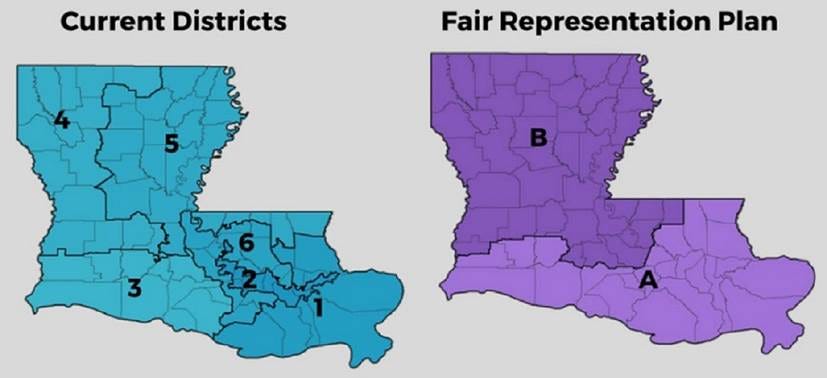
In the Fair Representation Plan (purple map), districts A and B would both have three seats, and would each contain half of the state’s population. Using proportional ranked choice voting, any candidate that receives 25% of the vote in one of those three-seat districts would win a seat. Candidates could run district-wide, or more likely would try to win their votes in the region(s) of the district where she or he is most popular. So this configuration would create a flexible mix of some geographic-based representation combined with regional and city representation. Democrats and Republican voters throughout the state would be able to elect winners in proportion to their overall share of the popular vote.
Based on FairVote’s proposed plan, grounded in a preliminary analysis of the latest demographic data, in all likelihood Republicans would elect four of these six seats (instead of the soon-to-be five); and Democrats would elect two seats, both of them potentially black Democrats. African American voters in Louisiana would have the power to elect one of their preferred candidates in each district, even assuming extreme racially polarized voting, because they are over 25% of each district’s voting population. Moreover, instead of the unfair and racially biased plan that will be used in this November’s election, in which only those small number of black voters that live in the heavily Democratic and black district around New Orleans are able to elect a representative, with the Fair Representation Plan fully 100% of African-Americans, no matter where they live, would be able to cast a vote in a district that would elect a black representative. Currently “orphaned” black voters, whose votes don’t help elect anyone, would have an electoral home. The same could be said for white Republican voters, no matter where they live.
That in turn means that candidates would be visiting these voters’ townships and communities, making campaign promises and asking for their votes. Entire regions of the state that currently have no electoral hope whatsoever of casting a vote that impacts final outcomes suddenly would be valued and empowered.
A similar retrenchment in racial representation has occurred in next-door Alabama. Alabama’s 2023 redrawing, which was struck down by a lower federal court as intentionally discriminatory, has been restored by the US Supreme Court, post-Callais. Like Louisiana’s new map, it eliminates one of the state’s two majority-Black districts, in part by gerrymandering the line so that Mobile and Montgomery, two majority-Black cities that are reliable Democratic-leaning areas, are now in two separate districts, one of those districts being heavily Republican.
But what if…Alabama’s seven single-seat House members were elected from one three-seat district (25% victory threshold) and one four-seat district (20% victory threshold). This would result in four Republican seats (instead of the soon-to-be six), two Democratic seats (instead of currently one), and one swing seat that either party could win, introducing some real competition in Alabama for the first time in decades. Blacks would potentially fill the two Democratic seats. Perhaps even a black Republican would win a seat.
Proportional ranked choice voting does not favor any one political party, it is designed to ensure that all parties win their fair share of representation. In Massachusetts, Democrats currently win all nine of the U.S. House seats, as if there isn’t a single Republican in the entire state deserving of representation. If Massachusetts used PRCV, Republicans would likely win three of those nine seats.
Currently these five Deep South states with large black populations elect ten black House members out of the 38 seats up for grabs. But FairVote’s “full representation” plans would likely result in13 to 14 seats for black congressmembers. And black voters would be empowered no matter where they live, instead of only in the handful of districts that have been racially gerrymandered. Formerly orphaned black voters would have an effective vote that actually counts towards electing their preferred representative.
Indeed, the number of African Americans living in a district with high enough population numbers to reach the victory threshold would more than double, going from currently 40% to 98% of black voters. In FairVote’s plan for North Carolina, the percentage of black voters with an effective vote would increase from 19% to 100%. Latino voters also would be closer to the victory threshold in many states; and more white moderates would certainly get elected to Congress.
Using FairVote’s representation plans based on multi-seat districts and ranked choice voting, broad representation would be accomplished in competitive elections without gerrymandering a single district, or worrying about judicial courts sabotaging it all. House elections would result in elected representatives that more accurately reflect the actual demographics of the South today. And different communities of interest, even if they are polarized, would no longer be fighting over a limited commodity – political representation in winner-take-all districts. Each side would be able to win its fair share of representation, drawing from its base of supporters but also using the ranked ballots to build broader coalitions and attract more voters. That in turn would help lessen the degree of division and polarization.
Bi-partisan potential in the West and Northeast
If the racially-divided South can implement an electoral system that provides diverse and less polarizing representation, then anywhere can. Using multi-seat districts with RCV in other regions of the country would yield similar results. In New England, moderate Rockefeller Republicans, once a granitic mainstay of Yankee politics that have also become an extinct species, would be electorally viable again. In the Mountain and Prairie states—which in recent years have experienced a virtual avalanche of extreme polarization amidst right-wing gains that threaten post-democratic breakdown – it would be possible to once again elect moderate Republicans like former Montana governor Marc Racicot and the Solutions Caucus, and moderate Democrats like Rep. Pat Williams.
In the 2018 midterm elections, congressional Republicans’ biggest losses came among their most moderate members, further widening the partisan divide. Mavericks like Republican Congressmen Adam Kinzinger and John Katko, and Democrat Stephanie Murphy, who have recently declined to run for reelection because of pressure from extremists within their parties, would be able to cultivate support from both Republican and Democratic moderates in their multi-seat districts. With more moderates getting elected, the resulting cross-fertilization in Republican and Democratic party caucuses would lessen some of the polarization and harsh rancor that now infects the United States Congress.
Following the recent Supreme Court-licensed mid-decade redistricting, in which 10 states – Alabama, California, Florida, Louisiana, Missouri, North Carolina, Ohio, Tennessee, Texas, and Utah -- rejiggered their district lines to make even more seats uncompetitive, perhaps 20 House seats out of 435 are considered “competitive” for either major party to win. Even more districts have become lopsided one-party fiefdoms. Multi-seat districts elected through PRCV would stir up this racket of incumbent protection and lack of competition, and would give more moderate candidates a chance of winning.
There is much to gain from the use of proportional representation electoral systems in the South, West, Northeast and elsewhere -- from diverse representation and more minority voters actually helping to elect their favorite candidates without gerrymandered districts, to moderate voters having a chance to elect moderate representatives, to a reduction in geographic-based polarization, to independent voters and candidates having a chance to win a seat by reaching the lower (25%) victory threshold, to orphaned voters everywhere having an opportunity to cast a vote that helps elect their preferred representatives.
Any of the 50 state legislatures could adopt multi-seat districts right now, and elect those seats using proportional voting. And if Congress changed one federal law that mandates single-seat districts to simply allow an option of using multi-seat districts, then various states could try using proportional voting to elect their US House delegations. No changes to the US Constitution are necessary.
Americans just need to get outside the rusty iron box that we have entombed ourselves in, and try the magic of multi-seat districts elected by ranked choice voting. This and other proportional voting methods are already being used by most of the world’s established democracies.
Oh, the answer to the riddle… of who discovered water? It was a flying fish.
Steven Hill @StevenHill1776 bsky.social @StevenHill1776
Good stuff! I mean, it'd be even more democratic if you used SCTV to produce PR and had each elected representative's voting authority track their own percentage of votes received in the relevant election, but so much better than what we have now that it's silly to quibble.
I like proposals to use game theory in the redistricting process. I think these have a greater chance of being adopted. They would apply to multi-member redistricting as well, so in some sense the proposals are orthogonal. For examples, see
https://www.ifo.de/en/cesifo/competitive-gerrymandering-and-popular-vote
https://www.cambridge.org/core/journals/american-political-science-review/article/redistricting-reforms-reduce-gerrymandering-by-constraining-partisan-actors/5D85E711B3C401F0D24A9B7BB8C50337